
This project focused on creating a standalone system that reads distance data from an ultrasonic sensor and displays the information on an I2C LCD screen using an Arduino Uno. The goal was to integrate sensor readings with real-time data display. This is a fundamental concept in smart device applications.
Hardware Setup
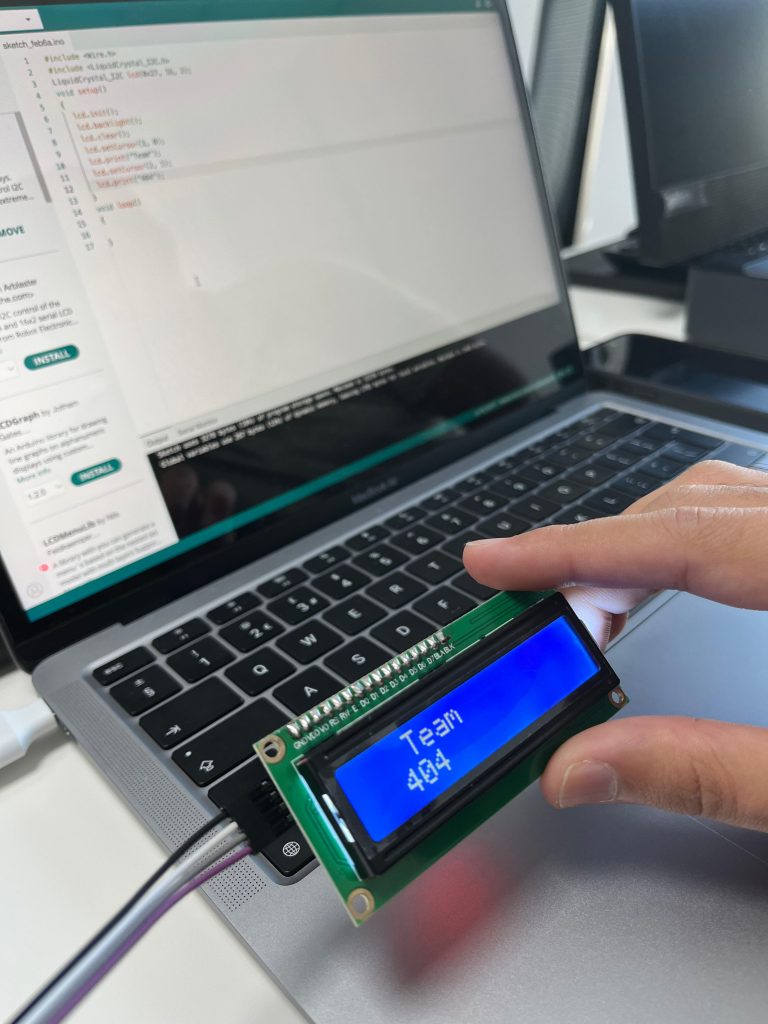
I began by connecting the ultrasonic sensor and the I2C LCD to the Arduino Uno. The ultrasonic sensor measures distance by emitting ultrasonic waves and calculating the time it takes for the echo to return. Meanwhile, the I2C LCD simplifies wiring by using just two communication lines (SDA and SCL) to display the sensor readings. Ensuring proper and secure connections was essential for accurate data acquisition and display.
Software Integration
Using the Arduino IDE, I developed a simple program to read the ultrasonic sensor’s data and send it to the LCD screen. The code flow is following:
- Initializes the I2C LCD and ultrasonic sensor.
- Continuously measures the distance.
- Updates the LCD with the current distance value.
This project showcased the integration of sensor input with display output, highlighting how real-time data processing can be managed with minimal hardware.
Key Takeaways
- Efficient Communication: The I2C protocol simplifies connections and reduces wiring complexity.
- Real-Time Monitoring: The ultrasonic sensor provides immediate feedback, which is essential for responsive systems.
- System Integration: Combining these components on a standalone Arduino Uno emphasizes how simple modules can be used to build smart, interactive systems.
This beginner-friendly yet robust project demonstrates the practical applications of integrating sensors with display technology. It sets a strong foundation for exploring more advanced embedded systems in future projects.


